(10 virtual chocolate chip cookies if you can guess where the title line is from.)
I'm a fan of period dramas, most of which are based on books.
(My favorites are Washington Square, Jane Eyre, North & South, and Pride & Prejudice.)
I don't remember precisely when my appreciation for these dramas began. Ever since my early teenage years, I delved into the realm of thoughts; life, existence, purpose, and of course, my admiration of truly meaningful relationships. In particular, I remember enjoying these period-dramas during my late high school years. High school was enough of a drag, and I often tuned it out by creating my own exclusive emotional paradise.
What can I say? I'm a hopeless (hopeful?) romantic till the end.
Jane Austen is commonly the most famous of the period-drama authors. All of her storylines, as well as many of the others, often share similar themes:
1) opposites attract
2) first impressions and stereotypes are often misjudgments; there's more to a person than what meets the eye.
The poor gal with the rich guy. The smart, chutzpahdik fair maiden with the proper mannered fellow. The rude, conceited guy who turns out to have many layers to him -- and is in fact a kind-hearted and sensitive individual. The plain-looking gal with the ravishing, wealthy dude.
Those who were at first repulsed by each other eventually become head-over-heels in love, not because of their physical attributes, family, or fortune, rather because of their virtues and morals.
One of my favorite dialogues in Pride and Prejudice:Mr. Darcy: Miss Elizabeth. I have struggled in vain, and I can bear it no longer. These past months have been a torment. I came to Rosings with the single object of seeing you...I had to see you. I have fought against my better judgment, my family's expectations, the inferiority of your birth by rank and circumstance. All these things I am willing to put aside and ask you to end my agony.
Elizabeth: I don't understand.
Mr. Darcy: I love you. Most ardently. Please do me the honor of accepting my hand.
Elizabeth: Sir, I appreciate the struggle you have been through, and I am very sorry to have caused you pain. Believe me, it was unconsciously done.
Mr. Darcy: Is this your reply?
Elizabeth: Yes, sir.
Mr. Darcy: Are you...are you laughing at me?
Elizabeth: No.
Mr. Darcy: Are you rejecting me?
Elizabeth: I'm sure that the feelings which, as you've told me have hindered your regard, will help you in overcoming it.
Mr. Darcy: Might I ask why, with so little endeavor at civility, I am thus repulsed?
Elizabeth: And I might as well enquire why, with so evident a design of insulting me, you chose to tell me that you liked me against your better judgment.
Do they get married and experience true love in the end?
It might be the storyline, the characters, the raw emotions, the professions of love, the beautiful scenery, or a combination of all the above that hooks me and leads me to wonder...
perhaps misjudgements are often prematurely made in life, especially when it comes to dating. Do people always deserve a second chance? Or do these stories only exist in fantasy, period-drama-novel-movie land?
Wednesday, January 12, 2011

Sunday, January 9, 2011
Are You a Beeper or a Pusher?
Rabbi Fischel Shachter related a touching story. His car got stuck in the middle of a hill in boro park on a Friday afternoon. Cars were honking and beeping at him, and a truck behind him stopped. The driver was a chassidish man, and he asked Rabbi Shachter what the problem is. When he found out that the Rabbi Shachter's brakes stopped, he turned around and said to the drivers: "what are you all waiting for? Get out and push!" And around a dozen men got out and pushed his car all the way to the mechanic.
Rabbi Shachter shared a profound thought that occurred to him at that moment. After 120, when you go up to Shamayim, you will be asked what kind of person you were in this world.
There are two categories: those who honk & beep and those who get out & push.
In other words: are you a person who gets angry, depressed, and frustrated when you deal with adversity, or do you try to make a difference and actively make the best out of your situation?
If someone upsets or offends you, do you get mad at them and lash out at them? Or do you try to give them the benefit of the doubt, do your best to forgive them, and pray for them to have opportunities to do teshuva and grow closer to HaShem?
If you hear that someone is sick, do you just say "aw man, that's too bad" or "that's terrible! Why him?!" or "wow, he needs as many teflliot as he can get! I'm going to say a perek of Tehillim for him." And if you can't say a perek of Tehillim - how about a heartfelt tefillah in your own words? "HaShem, I just heard that my fellow Jew, ploni ben ploni, is ill. How much pain he must be in...
please, G-d, Master of the Universe, send him a speedy and full recovery. Please help him feel better."
There are people who scream. And then there are those who push.
The one who mainly beeps (screams) is just reacting a lot and giving in to his impulses, but l'maaseh, he doesn't DO anything to change his situation for the better. If anything, his negative reaction just make his situation worse and even more disasterous! At that point, he gives into despair. He's pessimistic, he's helpless.
The one who pushes, however, proactively hopes for the better. He has emunah, he prays, he's optimistic, and he fights through the situation, building his character and improving his situation! He knows that everything is for the best and that he can make a change. Nothing is out of the reach of his potential!
You have to keep going in life to get anywhere! Trust in HaShem; He runs the world. He is the best friend you can ever have. He's never too busy for you; He's always there for you...24 hours a day, 7 days a week. He's understanding, merciful, forgiving, kind, giving, and All Mighty. He knows your each and every fiber, thought, and emotion. Your financial situation, your health, your family, your maritial status, your grades at school -- He completely knows your situation; there are no secrets with Him. Nothing is impossible for Him. He loves you more than you can even fathom.
As David Hamelech writes in Tehillim: "G-d is close to all who call upon Him."
Shavua tov :)
Friday, January 7, 2011
Mi K'amcha K'Yisrael?
Baruch HaShem, I recently heard a life changing shiur.
Here's a very moving snippet of the amazing shiur:
A girl asked Rabbi Wallerstein -- "if HaShem loves us so much, then why did He give us 613 restrictions, while the goyim get 7 mitzvot bnei noach? If I had two children, and I loved one more than the other, I would give my beloved, favored son 7 simple chores and give the less loved one 613 chores/commands! So how can you possibly say that mitzvot are treasures and means to get closer to HaShem? How can we possibly enjoy doing them? How are they NOT burdensome?
The Rabbi's beautiful answer:
A big broadway producer, who won many awards and had a prestigious and honorable reputation in show business, was producing a new play that consisted mainly of dancing. During the auditions, she saw dancer, after dancer, after dancer. She didn't see the "wow" factor in any -- they were all ordinary dancers, and she was searching for an amazing dancer. A STAR. All of the sudden, one dancer comes in and WOWS the whole crowd. There were dance moves that were never even seen before, and the choreography was extremely unique. The producer was in awe. She jumped up and excitedly told the dancer "in my 40 years of show business, I have never seen anybody who has so much talent. You've got the part! This play will involve very rigorous dance moves, to show off your incredible talent and stun the audience. It will involve 613 different routines, and out of the three hours that the play consists of, you will be in just about every scene; almost three hours! 613 different moves all in one play! So, are you interested? Are you up for the challenge?"
The dancer thought about it. How she'll be written about in the magazines and receive wonderful reviews from critics. Sure, the rehearsals would be difficult and take a lot of work, but it's worth it! It's such an honor to be selected by a broadway producer and to show your talent to the world.
Every performer wants MORE time on stage. She would be the leader; the star! Of course, she gladly took the part.
The producer called over one of the ordinary dancers who auditioned. "You've got a part in the play. You'll have to practice a few basic dance moves, and basically, you'll perform for 7 seconds out of the 3 hour show. Are you interested?" It was broadway, of course, so she took the part. Afterall, 7 seconds is better than none!
This show went on for 20 years and continued to get great and raving reviews. The producer and dancer became extremely close to each other. She knew the dancer's every move -- when she was upset, when she was happy, which dance move was in which scene, etc. What was the producer's relationship with the 7 second dancer? Existing and significant, but in comparison to the main star, barely comparable!
This is a mashal to our relationship with HaShem. It is a privilege! He went to different nations, and they all said they can't be the main dancer (the main nation) in this play (the world). They asked HaShem what's in the Torah, and when He told them, they declined His offer. So, instead of giving them the Holy Torah with 613 mitzvot, He gave each nation 7 mitzvot.
The last one to audition in the big play, (the 6,000 years of this world), was Am Yisrael. HaShem said "show me your best!" -- and they said "Naaseh veh Nishma." And then HaShem said - "you've got the job! I'll give you 613 movements to practice for the play, and each movement in the dance will bring you closer to Me."
How can one complain that (s)he got the main part in the play, instead of the 7 seconds? One's outlook should be: I want to dance for HaShem every day! Every moment that I possibly can! I want to be on that stage. I want to be the main dancer, the main singer, the main actor. The main star! Who wants the 7 second job?
We need to view mitzvot as absolute treasures. 613 precious treasures. 613 guidelines towards our mission in this world. They're expressions of love for HaShem and appreciation for choosing us to be the Am Segulah. They're not 613 chores, chas v'shalom!
When one has this outlook, how can (s)he ever resent a mitzvah? On the contrary,(s)he looks forward to every mitzvah! (S)he looks forward to take every opportunity to pray, to help someone, to make a bracha, to learn more about Judaism; all in order to form (and keep) a relationship with HaShem.
The Jewe prides himself on good middot and strong emunah. The Jewess is a princess; the Jew is a prince. All of our fellow Jews are fellow princesses and princes and should be treated as such. All because HaShem is our King.
As Rabbi Benzion Klatzko beautifully said in his shiur -- "Judaism is not a religion. It's a relationship!"
With that outlook in mind, what is Shabbat? Shabbat is 25-26 hours of connecting to HaShem on every level! It has all the joys of the world that we can possibly experience, and holiness that is beyond basic comprehension. Shabbat is about tefillah, rest from the MUNDANE of our week (school, work, textbooks, paper, our cell phones, our cars, etc.) in order to focus on what REALLY counts -- olam habah, HaShem, learning Torah, mitzvot, family, spirituality, our neshamot!
May we embrace the Shabbat Queen and our neshama yetera with full ahavah and emunah, and may this chodesh shvat be full of "besorot tovot" - only good news, health, happiness, clarity, and closeness to HaKadosh Baruch Hu!
(Shevat = Shin.Bet.Vet. = "sh'yehiyu be'sorot tovot")
Shabbat shalom u'mevurach! :)
Sunday, January 2, 2011
Fancy meeting you here...
I was doing some winter shopping and spotted a nice hat. I tried it on and modeled it in front of the store's full length mirror. A pretty lady passed by and said "cute hat! Looks great on you." I smiled and thanked her. It's pretty neat how a friendly comment can boost someone's mood.
I continued browsing around, and the same lady stopped me again. She asked me for some clothing advice. We started chatting, and then the question came...
"are you Jewish?"
I was taken aback. In a good way. I mean, usually non-Jews can't tell that I'm Jewish. Due to my dark features, they assume I'm Arab. True. I'm a Jewish Arab. But most people are unaware that there are Jewish Arabs (sefardim/mizrachim.) So, to them, I suppose I'm either Middle Eastern Muslim/Christian or Hispanic looking.
Sometimes it works to my advantage -- like when the Muslim dude at a boutique gave me a discount because he assumed I was Muslim.
"Yes, I am."
"Ohhh, I love youz Jewish girls! I can tell by the way y'all dress. Y'all look so put together and nice."
We started chatting more...like how she knows about frum Jews and stuff. And then IT happened. The dreaded, yet beloved, topic came up: SHIDDUCHIM.
Yes, SHE initiated it.
"I saw a movie...about a religious girl who got matchmade by -- oh man, what's the name of that lady? The one who makes the matches...?"
"A shadchan?"
"Yes! Sha-haan. Anyway, it was so sad because she was forced in da marriage and then falls in love wit someone else! Oh, I just love watching these kind of movies. There's absolutely nothing as amazing in this world as finding your one true soulmate. Your true love." She said it with so much emotion that I knew she was talking from experience.
I nodded. I'm sure it is amazing. *sigh*
Can I really not escape this topic? I looked up. HaShem, You have an AWESOME sense of humor. No matter where I am --- the topic of shidduchim, dating, marriage, etc. simply HAS to come up. At shiurim, with family, with friends, at school, work, home, restaurants, the doctor's office, supermarkets, Shul on the subway, on the plane, when I'm getting a haircut, etc.
But at department stores? Really?
Know what? I'm not even going to ask why.
I continued roaming around the store, newly aware that some people actually know that I'm Jewish. And frum! Woo-hoo! :)
In case anyone is wondering, I bought the hat and some other nice stuffado0o too. It was a shopping success. Now bring on the winter!
Monday, December 27, 2010
What I've Learned About "Snow Days"

In no particular order:
1. You might expect to be super productive (clean your room, finish studying, write essays, exercise, etc.) but it's possible you'll neglect all of those goals and instead find yourself surfing the net, talking on the phone, basking in pjamas, etc.
2. Snow Days were way more exciting when you were 10 years old.
3. It's difficult to find somebody who wants to build a snowman with you! Or have snowball fights :(
4. I'm expected to clean the snow. Never mind the fact that I have no idea how to shovel normally, don't own any pair of boots that I want to ruin, and that I'm A WOMAN. When it comes to snow-relating matters, I definitely prefer to live in a male-chauvinistic society.
Apparently, the teenage snow-cleaning boys don't want to make $20 anymore. None of them rang the doorbell. (If anyone knows one who's willing, I'll pay $100-200...)
5. Animal foorprints in the snow really freak me out.
6. People like to bake and cook during snow days. One friend baked danishes, another made blueberry muffins, another made oatmeal cookies and banana cake, and I made... (drumroll please!)
hot chocolate souffle with ice cream on the side.
7. Diets don't apply during snow days.
8. Okay, FINE. You caught me. I didn't really make hot chocolate souffle -- I attempted to make a brownie cake, but because it was dairy and my oven is meat, I quazillioned-triple-abillion-double wrapped it. As a result, most of the cake baked normally, except for the middle -- which resembled chocolate pudding because it didn't quite solidify. The cake (and "pudding") was still hot, so therefore, it kinda qualifies as hot chocolate souffle.
9. Some people actually have the guts to drive in the snow, while my car will probably still be buried until the snow decides to melt.
10. Snow days might be a test from HaShem -- to appreciate His wonders of "nature" and use our free time for shiurim, learning, and chessed opportunities (as Conversations in Klal wisely mentioned -- checking on our ill or elderly neighbors and seeing if they need any help with shoveling or perhaps buying them groceries/food.)
11. This made me laugh:

Sunday, December 26, 2010
ICE CREAM
Some of my readers might've notice that I've cut off a significant chunk of my blog (if I recall correctly, around 50 posts) over the past few weeks.
Why have I done so?
Well, by now, y'all should know that I'm a bit crazed. That's nothing new.
But there are other reasons.
So, what is the focus of this blog now?
Divrei Torah? Halachot? Emunah? Spirituality? Tefillah? Rants? Israel? Goals? Dating/marriage? Politics? Random shtuyot? Sefardi culture?
Truth is that the focus is currently none and all of the above. The answer is merely summed up with one word: thoughts.
Are they mine? Usually.
Do I occasionally posess an alter-ego? Perhaps.
Does my blog define me? Not entirely.
Do I plan on updating regularly? Maybe.
So, what's the purpose of this blog? Honestly, I'm not sure.
It's a journey. Stick around if you wish. :)
Saturday, December 25, 2010
Rimonim Are Super Cool
So, I was chopping up some veggies for a salad l'kavod Shabbat, while my eyes were dialated (gotta love check ups at the eye doctor.) Still had 3850238230482030202 things do before Shabbat. I had just cleaned the table and kitchen countertop, and everything was sparkly clean. Mission accomplished.
On my way to clean my room, I noticed two special friends chilling on the living room table. Pomegrantes!!!
I got so happy. I mean, come on, when do you get to see pomegrantes other than Rosh Hashana time???
Why not open one up l'kavod Shabbat? Nutty person that I am, that's precisely what I did; I opened one up...forgetting how messy pomegrantes can be.
Now, anybody who has the fun task of opening up pomegrantes for Rosh Hashana knows that:
1) the fruit's juice can get messy and leak all over the place, regardless of how careful you are
2) it can leave a temporary or permanent stain on anything and everything; your clothing, your hands, the table, etc, and for the most part, if it stains your clothes -- the stain lasts forever and ever...and ever.
3) A pomegrante contains many red pieces/seeds of fruits, and also white pieces/skin that often get mixed up with the seeds, and if you eat the red part of the fruit along with the white skin thingy, there's an extremely bitter taste -- unless you remove the white particles before consuming any.
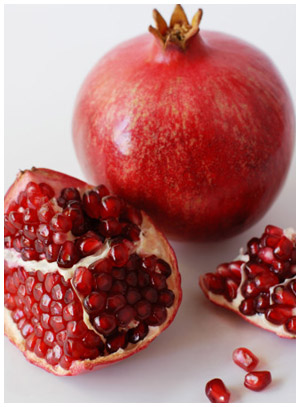
So, I was humming the tune to one of my favorite songs while opening the pomegrante, thinking about how the pomegrante symbolizes the 613 mitzvot.
Now, there's something to learn from everything in this world. Every person, every creature, every object, etc. Some thoughts came to mind. Not sure if these ideas are chiddushim or if these are concepts that many have thought of before.
1) If a pomegrante stains your shirt, the stain basically lasts forever. Since a pomegrante symbolizes mitzvot, a mitzvah -- too -- is eternal. Even if somebody isn't the most observant or holiest person around, (s)he should never think "oh, what good will 1 mitzvah do if I negelect the other 612?" Because each mitzvah can make a long lasting impression!
I heard the following incredible thought from a project inspire Rabbi: if thousands of diamonds fell to the ground in your neighborhood, and everybody rushed to collect them, would you refrain from attempting to collect any just because you can't obtain them all? Absolutely not! Even 1 would make a difference. It's the same with mitzvot. Each mitzvah, no matter how "small" or "big", is counted and precious.
2) Now, in certain cases, the pomegrante juice appears to leave a stain -- but the stain is removable. For example, if the pomegrante juice leaks onto your kitchen countertop. If you merely wipe it off with a napkin, it doesn't fully disappear and deceitfully makes you think that it's permanent. That's it! Your countertop is RUINED. Your mom or wife or room-mate is going to kiiiiiilllll you. But, if one would just apply more effort -- such as scrubbing the stain with a towel and hot water, or perhaps some bleach/detergent/ammonia cleaning device, then the stain can completely vanish!
This is a metaphor for an avera (sin). If someone commits a sin, "small" or "big", the stain seems like it can last forever. That's it. I'm doomed. I'll be punished forever. But that's not the case --- that's ONLY the case if the sin is left in the past, or even if it is continuously committed. If one does teshuva, which initially just requires effort, it can all be erased. As if there was never any stain!
3) When one opens the pomegrante, and the pieces are placed into the bowl, the white, bitter pieces also get mixed in and must be taken out (unless one enjoys eating bitter foods.) As sweet as the red fruit particles of the pomegrante are, if they are eaten along with the white particles, the sweet taste is maxed out, and the main taste is the bitterness. The person who is opening the fruit makes sure to pick out the white pieces before eating the fruit.
When we fulfill mitzvot, at times, there's a tendecy to do so without kavana or even with the wrong kavanot. These are methods of the yetzer hara -- he knows he can't completely cause a dedicated Torah-true Jew to STOP doing mitzvot, so he makes us stumble on the "little" things. For example, a Jew who makes it to minyan on time and has his siddur ready and everything...but then he mumbles and slurs the words of the Shemoneh Esreh, thus making his Shemoneh Esreh barely, if at all, valid. Another example is tzniut for women -- the yetzer hara knows he can't convince most Torah-true bnot Melech to wear pants, but he tries to convince us to be more lax in our observance by making tight and shorter skirts look more appealing than longer ones.
We must learn to throw away the bitter white parts (the yetzer hara; laziness, laxness, impatience, lack of concentration, etc.)that often get involved if fulfilling a mitzvah -- so that we can focus on the sweet red part (fulfilling the mitzvah, doing G-d's will, loving and fearing HaShem, being happy, receiving olam haba, etc.)
David Hamelech explains that we need to
"סוּר מֵרָע, וַעֲשֵׂה-טוֹב; בַּקֵּשׁ שָׁלוֹם וְרָדְפֵהוּ" (Tehillim 34:15), meaning "avoid/remove/turn from evil and do good; seek peace and pursue it.)
One of HaShem's Names is "Shalom" -- which also means "peace". We need to seek "peace" (HaShem) and "pursue [Him]" (pray and put those prayers into action!)
Even if we pinpoint who or what the yetzer hara is and how he manifests himself into certain parts our lives, we must know that we can't fight him alone -- we need HaShem's help. We need to pray to Him that we can fight off all of the distractions in our lives, overcome the difficulties, purely serve Him to the best of our abilities and potential, and continue to have emunah in HaShem and know that He has the power to do anything! If He brought us to it, He can bring us through it.
Stay tuned for next week's "thoughts on watermelons"...
(just kidding. I miss those guys, though! Why aren't they in season??)
Shavua tov :)
On my way to clean my room, I noticed two special friends chilling on the living room table. Pomegrantes!!!
I got so happy. I mean, come on, when do you get to see pomegrantes other than Rosh Hashana time???
Why not open one up l'kavod Shabbat? Nutty person that I am, that's precisely what I did; I opened one up...forgetting how messy pomegrantes can be.
Now, anybody who has the fun task of opening up pomegrantes for Rosh Hashana knows that:
1) the fruit's juice can get messy and leak all over the place, regardless of how careful you are
2) it can leave a temporary or permanent stain on anything and everything; your clothing, your hands, the table, etc, and for the most part, if it stains your clothes -- the stain lasts forever and ever...and ever.
3) A pomegrante contains many red pieces/seeds of fruits, and also white pieces/skin that often get mixed up with the seeds, and if you eat the red part of the fruit along with the white skin thingy, there's an extremely bitter taste -- unless you remove the white particles before consuming any.
So, I was humming the tune to one of my favorite songs while opening the pomegrante, thinking about how the pomegrante symbolizes the 613 mitzvot.
Now, there's something to learn from everything in this world. Every person, every creature, every object, etc. Some thoughts came to mind. Not sure if these ideas are chiddushim or if these are concepts that many have thought of before.
1) If a pomegrante stains your shirt, the stain basically lasts forever. Since a pomegrante symbolizes mitzvot, a mitzvah -- too -- is eternal. Even if somebody isn't the most observant or holiest person around, (s)he should never think "oh, what good will 1 mitzvah do if I negelect the other 612?" Because each mitzvah can make a long lasting impression!
I heard the following incredible thought from a project inspire Rabbi: if thousands of diamonds fell to the ground in your neighborhood, and everybody rushed to collect them, would you refrain from attempting to collect any just because you can't obtain them all? Absolutely not! Even 1 would make a difference. It's the same with mitzvot. Each mitzvah, no matter how "small" or "big", is counted and precious.
2) Now, in certain cases, the pomegrante juice appears to leave a stain -- but the stain is removable. For example, if the pomegrante juice leaks onto your kitchen countertop. If you merely wipe it off with a napkin, it doesn't fully disappear and deceitfully makes you think that it's permanent. That's it! Your countertop is RUINED. Your mom or wife or room-mate is going to kiiiiiilllll you. But, if one would just apply more effort -- such as scrubbing the stain with a towel and hot water, or perhaps some bleach/detergent/ammonia cleaning device, then the stain can completely vanish!
This is a metaphor for an avera (sin). If someone commits a sin, "small" or "big", the stain seems like it can last forever. That's it. I'm doomed. I'll be punished forever. But that's not the case --- that's ONLY the case if the sin is left in the past, or even if it is continuously committed. If one does teshuva, which initially just requires effort, it can all be erased. As if there was never any stain!
3) When one opens the pomegrante, and the pieces are placed into the bowl, the white, bitter pieces also get mixed in and must be taken out (unless one enjoys eating bitter foods.) As sweet as the red fruit particles of the pomegrante are, if they are eaten along with the white particles, the sweet taste is maxed out, and the main taste is the bitterness. The person who is opening the fruit makes sure to pick out the white pieces before eating the fruit.
When we fulfill mitzvot, at times, there's a tendecy to do so without kavana or even with the wrong kavanot. These are methods of the yetzer hara -- he knows he can't completely cause a dedicated Torah-true Jew to STOP doing mitzvot, so he makes us stumble on the "little" things. For example, a Jew who makes it to minyan on time and has his siddur ready and everything...but then he mumbles and slurs the words of the Shemoneh Esreh, thus making his Shemoneh Esreh barely, if at all, valid. Another example is tzniut for women -- the yetzer hara knows he can't convince most Torah-true bnot Melech to wear pants, but he tries to convince us to be more lax in our observance by making tight and shorter skirts look more appealing than longer ones.
We must learn to throw away the bitter white parts (the yetzer hara; laziness, laxness, impatience, lack of concentration, etc.)that often get involved if fulfilling a mitzvah -- so that we can focus on the sweet red part (fulfilling the mitzvah, doing G-d's will, loving and fearing HaShem, being happy, receiving olam haba, etc.)
David Hamelech explains that we need to
"סוּר מֵרָע, וַעֲשֵׂה-טוֹב; בַּקֵּשׁ שָׁלוֹם וְרָדְפֵהוּ" (Tehillim 34:15), meaning "avoid/remove/turn from evil and do good; seek peace and pursue it.)
One of HaShem's Names is "Shalom" -- which also means "peace". We need to seek "peace" (HaShem) and "pursue [Him]" (pray and put those prayers into action!)
Even if we pinpoint who or what the yetzer hara is and how he manifests himself into certain parts our lives, we must know that we can't fight him alone -- we need HaShem's help. We need to pray to Him that we can fight off all of the distractions in our lives, overcome the difficulties, purely serve Him to the best of our abilities and potential, and continue to have emunah in HaShem and know that He has the power to do anything! If He brought us to it, He can bring us through it.
Stay tuned for next week's "thoughts on watermelons"...
(just kidding. I miss those guys, though! Why aren't they in season??)
Shavua tov :)
Subscribe to:
Posts (Atom)